
Global Cyberattack Report: Worldwide Threat Landscape
Reporting period: 6 August – 6 November 2026 | Global coverage | Strategic and technical analysis
1. Executive summary
Cyberattacks have become a major operational, economic, national-security and geopolitical threat. During the three-month reporting period, a comprehensive global assessment should examine attacks against governments, financial institutions, telecommunications operators, healthcare providers, energy companies, manufacturing industries, cloud infrastructure and digital service providers.
This report is structured as a global cybersecurity threat-intelligence assessment, covering:
- Ransomware and double-extortion attacks.
- State-sponsored cyber espionage and advanced persistent threats (APTs).
- Data breaches and identity theft.
- Distributed Denial-of-Service (DDoS) attacks.
- Supply-chain and third-party compromises.
- Cloud, SaaS and enterprise infrastructure attacks.
- AI-assisted cyberattacks and automated exploitation.
- Critical infrastructure and national-security threats.
Important scope note: The reporting window is 6 August to 6 November 2026. Specific incidents, dates, victims, financial losses and attribution need to be verified against contemporaneous sources. I will distinguish confirmed reporting from threat trends and avoid presenting unverified incidents as facts.
2. Global cyberattack statistics
The following figures provide a quantitative picture of the threat landscape.
September 2026 – Global attack activity
2,803
Average weekly cyberattacks per organisation
+48%
Year-on-year increase
824
Reported ransomware attacks
1 in 91
Emails classified as phishing
Source: Check Point Research, September 2026. Check Point Blog
2.1 Ransomware statistics: August–October 2026
Two independent ransomware trackers provide useful evidence of the scale of activity. Their methodologies differ, so their figures should not be added together.
| Month | Comparitech recorded attacks | CYFIRMA publicly claimed victims |
|---|---|---|
| August | 1,034 | 1,170 |
| September | 823 | 862 |
| October | 1,020 | 1,178 |
Global ransomware activity
Monthly counts from two independent trackers; not confirmed unique incidents.
■ Comparitech
■ CYFIRMA
Sources: Comparitech and CYFIRMA. Comparitech+1
Key observation: October saw a substantial resurgence in ransomware activity. CYFIRMA recorded its highest monthly total since its tracking began, with 1,178 publicly claimed victims. Comparitech recorded 1,020 attacks. These are leak-site and tracker-based figures, not a census of all successful cyberattacks. Comparitech+1
2.2 Geographical distribution
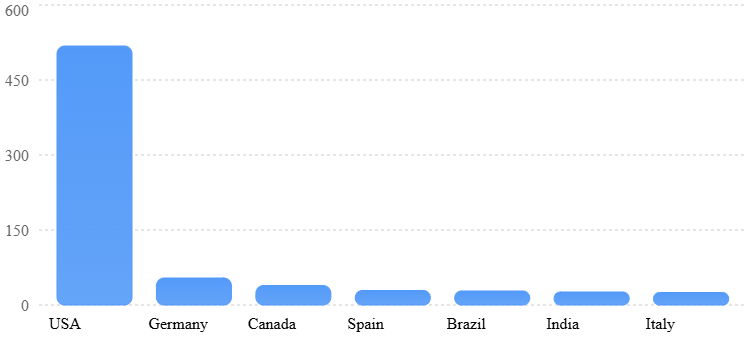
According to CYFIRMA’s October ransomware tracking:
| Country | Publicly claimed victims |
|---|---|
| United States | 518 |
| Germany | 54 |
| Canada | 39 |
| Spain | 29 |
| Brazil | 28 |
| India | 26 |
| Italy | 25 |
A total of 78 countries were represented in the tracker. The United States accounted for approximately 44% of recorded claims. CYFIRMA
October 2026 ransomware claims by country
CYFIRMA publicly disclosed victim counts.
3. Major cyber incidents and attacks worldwide
The following incidents are drawn from reporting available within the requested period. Some are confirmed by the affected organisations, while others are publicly reported claims or investigations.
3.1 Europe
The Reichstag and the Paul-Loebe-Haus at the river Spree
A. Berlin city administration – Germany
Ransomware / data exfiltration
31 August 2026
- The Rhysida ransomware group targeted two Senate departments within Berlin’s state administration network.
- Approximately 5.79 TB of data was reportedly exfiltrated.
- Exposed material included personnel records, financial documents, credentials and sensitive government information.
- The attackers demanded 30 Bitcoin.
- Berlin stated that it would not pay the ransom.
Security implications: Government networks can become a source of highly sensitive personal, financial and administrative information. September 2026+1
B. Polish healthcare sector – Poland
Healthcare data breach
25 September 2026
- A second reported cyberattack in several weeks affected Poland’s healthcare sector.
- Unauthorised access to medical data was reported.
- The identity of the attacker was not established in the cited report.
Security implications: Patient information is a high-value target because it contains personal, medical and identity information. September 2026
C. Tallinn Airport – Estonia
Service disruption – cause technical
4 August 2026
- Automated border-control gates became unavailable for outbound passengers.
- The gates were progressively restored following restarts.
- Estonia’s Information System Authority reported the event as a technical failure, not a confirmed cyberattack.
Security implications: This is an important example of why operational outages should not automatically be classified as cyber incidents. RIA
3.2 Asia-Pacific
Key considerations hanging over the approval of Simba-M1’s merger – The Business Times
D. SIMBA Telecommunications – Singapore
Customer data breach
September 2026
- A reported breach affected 23,549 customers.
- Information included names, identity card numbers, dates of birth, mobile numbers and email addresses.
- SIMBA reported that it contained and resolved the incident.
- Singapore’s Personal Data Protection Commission was investigating.
Security implications: Identity data can support targeted phishing, SIM swapping and identity fraud. CSIS
Metro in Tokyo: Tickets, Lines, Tokyo Metro & Toei Subway
E. Tokyo Metro – Japan
Unauthorised data access
September 2026
- An unauthorised third party accessed email addresses associated with up to 59,000 Metpo loyalty-programme subscribers.
- The operator contained the incident and identified a suspected access point.
Security implications: Customer loyalty databases can provide attackers with information for targeted social engineering. CSIS
F. Gyazo / Helpfeel – Japan
Large-scale data exposure
September 2026
- Approximately 23.62 million user records were reportedly affected.
- Exposed information could include names, email addresses, user IDs, password hashes, device IDs and authentication tokens.
- Metadata associated with approximately 490 million images was also accessed.
- The company reported blocking the access path and fixing the vulnerability.
Security implications: Authentication tokens and session identifiers can create risks beyond conventional password theft. CSIS
3.3 North America
G. Novocure – United States
Healthcare data breach
September 2026
- The oncology company reported unauthorised access to internal records.
- More than 1,400 patients were affected in the United States.
- Exposed information included patient identification numbers and healthcare-provider contact details.
- The organisation reported that its systems remained operational.
Security implications: Healthcare companies need to protect both clinical information and the supporting business and administrative systems. CSIS
H. Condé Nast – United States
Reported database sale – not confirmed by the company
September 2026
- A database allegedly containing 32.8 million user records was offered for sale on a Russian-language cybercrime forum.
- The reported information included names, email addresses, postal addresses, dates of birth and telephone numbers.
- The company had not publicly confirmed the breach in the cited reporting.
Security implications: Leaked customer databases can be reused for credential stuffing, targeted phishing and identity fraud. CSIS
3.4 Africa
I. South African Air Traffic and Navigation Services (ATNS)
Ransomware-linked malware investigation
September 2026
- ATNS reportedly discovered ransomware-linked malware in its operational technology (OT) networks.
- The organisation is responsible for air traffic operations and weather control across a substantial portion of global airspace.
- Early investigations highlighted possible data exfiltration to external IP addresses located in China.
- The available report does not establish that the Chinese government was responsible.
Security implications: Attacks against aviation OT systems can create risks to service availability, air traffic coordination and national critical infrastructure. CSIS
High Power Housing Service – Tokyo Fuchu Data Center | IDC Frontier Inc.
J. IDC Frontier – Japan
Cloud infrastructure ransomware
7 October 2026
- A ransomware attack affected the IDCF Cloud infrastructure platform.
- Four zones in its East Japan Region 1 experienced disruption.
- Approximately 495 companies and local government organisations were affected.
- The service is operated by a SoftBank subsidiary.
- The incident demonstrated how an attack on one cloud provider can affect many customers simultaneously.
Security implications: Cloud providers are high-value supply-chain targets. BleepingComputer+1
K. South Korean financial institutions – South Korea
AI-assisted cyberattack investigation
October 2026
- A series of suspected AI-assisted attacks targeted 16 financial institutions.
- Approximately 100,000 customer records were reportedly exposed.
- Daishin Securities, Mirae Asset Global Investments and cryptocurrency exchange Bithumb were among the organisations affected by a wider wave of attacks.
- The precise role of AI and the attribution of the incidents require further verification.
Security implications: Financial institutions must prepare for automated reconnaissance, phishing and faster exploitation. CSIS+1
L. Kamalnayan Bajaj Hospital – India
Healthcare ransomware
Attack reported from 18 October; news published 27 October 2026
- Nine hospital servers were reportedly hacked and their data encrypted.
- The Hospital Management Information System became inaccessible.
- Billing, insurance processing and government healthcare scheme operations were disrupted.
- Patients experienced delays in treatment, medicine dispensing and claim settlements.
- Police registered an FIR against unidentified cybercriminals.
Security implications: Ransomware in hospitals is not merely an IT problem; it can affect patient care and clinical operations. The Times of India+1
M. Norad Grants Portal – Norway
Account compromise and data exposure
Discovered 30 October; disclosed 3 November 2026
- Attackers abused 27 user accounts to access the grants portal.
- Names and email addresses associated with as many as 20,614 registered users may have been accessed.
- Applications and supporting documents from at least three organisations were compromised.
- The attackers’ identities remained unknown.
- The portal serves thousands of organisations internationally, including organisations operating in sensitive environments.
Security implications: Compromised legitimate accounts can provide attackers with access without requiring a conventional software exploit. Norad
3.5 Other significant October incidents
Several additional events illustrate the diversity of attacks:
| Organisation / country | Reported incident | Security significance |
|---|---|---|
| Danfoss, Denmark | Cyberattack affecting refrigerator control systems | Industrial operational technology |
| Fakturownia, Poland | Cyber incident affecting invoicing platform | Financial and business services |
| Dodo Pizza, Russia | Cyberattack disrupting services | Retail and customer operations |
| GMO Internet, Japan | Cyberattack affecting services and customers | Technology supply chain |
| U.S.NEXT, USA | Ransomware claim affecting nearly 70 government websites | Public-sector dependency |
| Femern Link Contractors, Denmark | Data theft and disruption | Construction infrastructure |
These incidents appear in national cybersecurity reporting and October ransomware tracking. Individual claims and the precise extent of impact vary by case. RIA+1
4. Major ransomware groups operating during the period
Ransomware has evolved from conventional file encryption into a sophisticated criminal business model involving initial access brokers, affiliates, data theft, extortion and negotiation services.
The October 2026 CYFIRMA tracking report identified the following leading groups:
| Ransomware group | October claimed victims | Operational characteristics |
|---|---|---|
| Qilin | 177 | Ransomware-as-a-Service and data extortion |
| The Gentlemen | 145 | Multi-platform ransomware operations |
| N0n | 142 | Rapidly expanding extortion activity |
| Akira | 34 | Enterprise and infrastructure targeting |
| NightSpire | 34 | Emerging extortion operation |
| Booba Project | 29 | Data theft and extortion |
| Silent Ransom Group | 29 | Enterprise intrusion and extortion |
| INC Ransom | 28 | Ransomware and data exfiltration |
| Emperador | 27 | Extortion activity |
| Everest | 25 | Data theft and ransomware |
Leading ransomware groups – October 2026
Number of publicly claimed victims recorded by CYFIRMA.
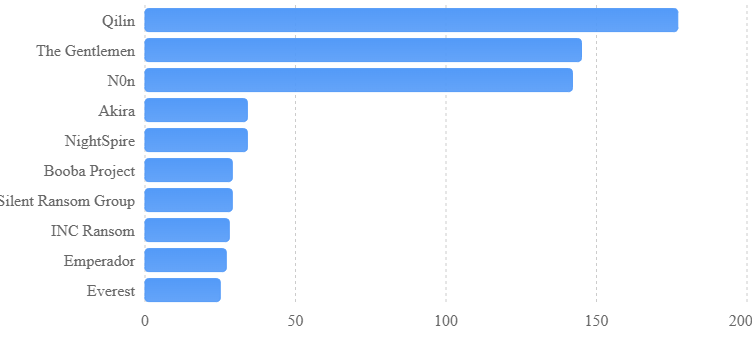
Source: CYFIRMA, Ransom Watch, 5 November 2026. These are attacker-published claims, not independently confirmed victim counts. CYFIRMA
4.1 Understanding the major groups
1. Qilin
- Operates a Ransomware-as-a-Service model.
- Uses affiliates to conduct attacks.
- Targets businesses, government, healthcare and manufacturing.
- Uses data theft and encryption to increase extortion pressure.
2. The Gentlemen
- A growing ransomware operation.
- Supports Windows, Linux and VMware ESXi environments.
- Combines initial access and ransomware operations.
3. Akira
- Targets enterprise networks and business infrastructure.
- Has targeted Windows and Linux systems.
- Uses data theft as part of its extortion strategy.
4. N0n
- Recorded a particularly sharp increase in October.
- Its claimed victims rose from 18 in September to 142 in October.
- Represents the rapid emergence of new extortion brands.
CYFIRMA+1
5. Most targeted industries
Cybercriminals generally target organisations where they can obtain valuable information, interrupt essential services or exert financial pressure.
According to CYFIRMA’s October tracking, the leading affected sectors were:
| Industry | Claimed victims |
|---|---|
| Professional goods and services | 170 |
| Manufacturing | 123 |
| Real estate and construction | 122 |
| Healthcare | 120 |
| Information technology | 96 |
| Consumer goods and services | 79 |
| Transportation and logistics | 71 |
| Government and civic | 57 |
| Education | 52 |
Most targeted industries – October 2026
CYFIRMA ransomware leak-site victim claims.
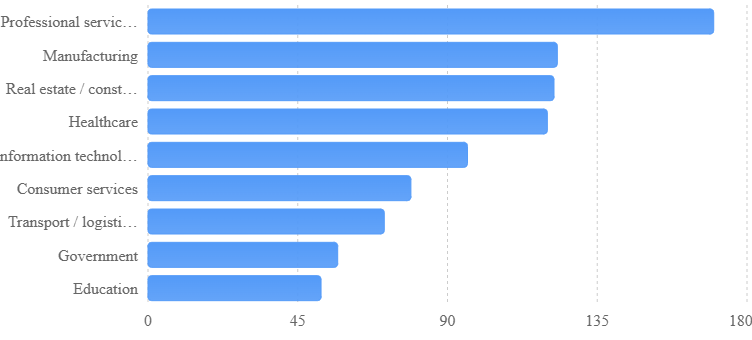
Source: CYFIRMA, October 2026. CYFIRMA
5.1 Why these industries are targeted
| Industry | What attackers seek | Potential impact |
|---|---|---|
| Banking and finance | Financial data, credentials, transactions | Financial fraud and service disruption |
| Healthcare | Patient records, clinical systems | Patient-care disruption and privacy breaches |
| Manufacturing | Production systems and intellectual property | Production shutdown |
| Telecom | Subscriber data, network access | Communication disruption |
| Government | Citizen information and official records | National security and public trust |
| Education | Student records and research data | Institutional disruption |
| Aviation | Flight operations and OT systems | Safety and operational risks |
| Energy | SCADA, ICS and control systems | Electricity and energy disruption |
| IT and cloud | Customer data and privileged access | Multi-customer compromise |
| Retail | Payment, customer and loyalty data | Fraud and reputational damage |
6. Major categories of cyberattacks
6.1 Ransomware and double extortion
German county targeted by ransomware asks military for help | Euractiv
Ransomware: The Data Exfiltration and Double Extortion Trends
Lateral Movement in Cyber Attacks: Techniques & Defense
8
Ransomware attackers typically:
- Gain access through stolen credentials or exploited vulnerabilities.
- Establish persistence within the network.
- Identify valuable systems and sensitive information.
- Steal data.
- Encrypt critical files and systems.
- Demand payment.
- Threaten to publish stolen information.
Double extortion is particularly dangerous because organisations face two simultaneous risks: operational disruption and public disclosure of confidential information.
6.2 Phishing and business email compromise
Business Email Compromise: A Growing Threat in 2025
Common techniques include:
- Fake invoices and payment requests.
- Impersonation of senior executives.
- Fake Microsoft 365 and Google login pages.
- QR-code phishing.
- Fake job advertisements and recruitment messages.
- Supplier and vendor impersonation.
- AI-generated messages in local languages.
Check Point reported that one in every 91 emails was classified as phishing in September 2026. Check Point Blog
6.3 Supply-chain attacks
What Is SaaS Security? | Definition & Explanation – Palo Alto Networks
Supply-chain attacks compromise a trusted software provider, cloud service, vendor or technology partner to reach multiple downstream organisations.
Examples from the reporting period include the IDC Frontier cloud ransomware incident and the reported GMO Internet attack.
The consequences can extend beyond the initially compromised company to its customers and partners. BleepingComputer+1
6.4 Cloud infrastructure attacks
Attackers increasingly target:
- Public cloud administration consoles.
- Cloud storage and exposed databases.
- Identity and access management systems.
- Kubernetes clusters.
- Virtual machines and hypervisors.
- Backup systems.
- Cloud API keys and service accounts.
A compromise of the cloud management plane can expose several customer environments simultaneously.
6.5 DDoS attacks
Large-scale DDoS attack hits web host 1-Grid | ITWeb
Distributed Denial-of-Service attacks flood systems with traffic from multiple sources.
Typical targets include:
- Government portals.
- Banking websites.
- Telecom networks.
- Airports.
- E-commerce platforms.
- Public digital services.
The objective is usually to disrupt availability rather than steal information.
6.6 AI-assisted cyberattacks
CrowdStrike warns AI will redefine cyber threats by 2026
AI is changing the economics and speed of cybercrime.
Potential applications include:
- Automated vulnerability discovery.
- Phishing message generation.
- Voice cloning and executive impersonation.
- Malware development assistance.
- Automated reconnaissance.
- Credential harvesting.
- Analysis of stolen data.
- Automated attack orchestration.
Reuters reported in October on suspected AI-assisted attacks involving South Korean and Japanese organisations, highlighting how AI can lower the technical barriers to cybercrime. Reuters
7. Emerging cyber threat trends: August–November 2026
Based on the incidents and threat-intelligence reports reviewed, the following developments deserve particular attention.
7.1 Attackers are targeting identity systems
Traditional perimeter security is no longer sufficient.
Attackers increasingly exploit:
- Compromised employee accounts.
- Stolen session tokens.
- Weak authentication mechanisms.
- Unprotected administrative accounts.
- Third-party identity providers.
- Privileged service accounts.
The Norad incident illustrates how compromised legitimate accounts can expose a large user population. Norad
7.2 Cloud service providers are attractive targets
The IDC Frontier incident demonstrates the concentration risk associated with cloud infrastructure.
A single provider compromise can affect hundreds of organisations.
Recommended security controls:
- Separate customer environments.
- Enforce privileged access management.
- Use immutable backups.
- Implement multi-region disaster recovery.
- Monitor cloud administration activities.
- Test incident response procedures.
7.3 Healthcare is becoming a critical ransomware target
Healthcare organisations are particularly vulnerable because of:
- Legacy hospital management systems.
- Connected medical devices.
- Third-party software.
- Large volumes of sensitive data.
- Dependence on continuous system availability.
The Kamalnayan Bajaj Hospital incident demonstrates the direct operational consequences of ransomware.
7.4 AI is accelerating the attack lifecycle
AI can assist attackers across multiple stages.
AI-assisted cyberattack lifecycle
- ReconnaissanceAI-assisted collection and analysis of information about employees, systems and organisations.
- Initial accessAutomated phishing, impersonation and credential attacks.
- ExploitationAssistance in discovering vulnerabilities and developing exploits.
- Privilege escalationIdentification of weak permissions and privileged accounts.
- Lateral movementExpansion from one compromised system to other network resources.
- Data exfiltrationIdentification and extraction of valuable information.
- ExtortionAutomated analysis and targeting of stolen data to increase pressure.
This is a threat model, not a claim that every stage was observed in every incident.
7.5 Critical infrastructure is increasingly exposed
The most concerning targets include:
- Power generation and distribution.
- Water treatment.
- Telecommunications.
- Aviation and airports.
- Railway networks.
- Oil and gas infrastructure.
- Industrial manufacturing.
An FBI/EPA advisory published in 2026 reported attacks against internet-facing programmable logic controllers used by water and wastewater utilities in at least seven US states since 27 July. Some incidents degraded water operations. FBI
This illustrates the importance of protecting operational technology separately from conventional IT networks.
8. India-specific cyber threat assessment
India is a major target because of its growing digital economy, extensive financial infrastructure, government digital services, telecom ecosystem and healthcare networks.
8.1 Important India-related developments
| Area | Incident or threat | Potential consequences |
|---|---|---|
| Healthcare | Kamalnayan Bajaj Hospital ransomware attack | Disruption of billing, insurance and treatment administration |
| Banking | State Bank of India customer records reportedly found on the dark web in October | Customer data exposure and fraud risks |
| Digital identity | Credential theft and phishing campaigns | Identity fraud and account takeover |
| IT services | Ransomware and third-party compromise | Client data exposure and operational disruption |
| Telecom | Subscriber data and network attacks | Privacy and communication risks |
| Government | Attacks against public-sector digital services | Citizen data exposure and service disruption |
The State Bank of India incident is reported in an October incident roundup; the exact scope and verification status should be established from the bank or regulator before treating it as a confirmed bank-wide breach. DKCISSP Blog
8.2 Indian cybersecurity priorities
India-based enterprises should prioritise the following areas:
- Banking and financial services cybersecurity.
- Healthcare information security.
- Telecom network security.
- Government and public-sector infrastructure.
- Cloud and data-centre protection.
- Software supply-chain security.
- Digital identity protection.
- AI security and governance.
- OT and industrial cybersecurity.
- Cybersecurity awareness and workforce development.
8.3 Regulatory and compliance considerations
Organisations operating in India should consider:
- CERT-In cybersecurity directions and incident-reporting requirements.
- Digital Personal Data Protection Act, 2023, and applicable rules and commencement provisions.
- RBI cybersecurity requirements for regulated financial entities.
- SEBI cybersecurity and cyber resilience requirements.
- Sector-specific requirements for telecom, power, healthcare and critical infrastructure.
- ISO/IEC 27001:2022.
- NIST Cybersecurity Framework 2.0.
Compliance requirements must be assessed against the organisation’s sector, regulatory status and applicable effective dates.
9. Cybersecurity risk assessment
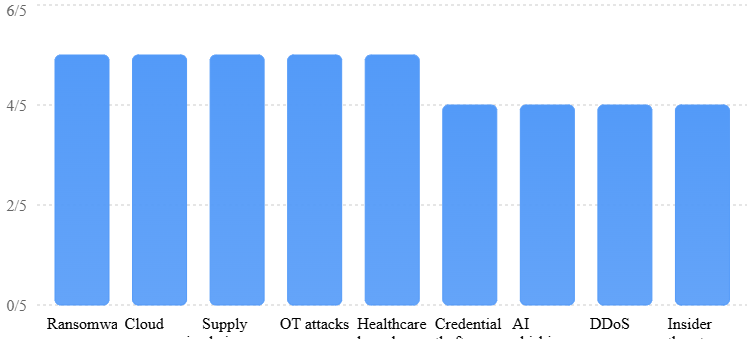
The following is a qualitative strategic assessment based on the observed incidents and attack patterns. It is not a statistical probability calculation.
| Threat category | Likelihood | Potential impact | Priority |
|---|---|---|---|
| Ransomware | Very high | Critical | Critical |
| Phishing and credential theft | Very high | High | Critical |
| Cloud infrastructure compromise | High | Critical | Critical |
| Supply-chain attacks | High | Critical | Critical |
| AI-assisted social engineering | High | High | High |
| Healthcare data breaches | High | Critical | Critical |
| DDoS attacks | High | High | High |
| Insider threats | Medium–high | High | High |
| OT and industrial attacks | Medium–high | Critical | Critical |
| State-sponsored espionage | High | Critical | Critical |
| Cryptocurrency-related attacks | High | High | High |
9.1 Cyber risk heat map
Qualitative cyber risk prioritisation
Illustrative impact scores assigned for strategic planning, not measured incident statistics.
10. Recommended cybersecurity defence architecture
Organisations should move towards an integrated security architecture rather than deploying isolated security products.
Invinsense XDR | AI-Driven Extended Detection & Response
10.1 Recommended security layers
| Layer | Recommended technologies | Purpose |
|---|---|---|
| Identity security | MFA, IAM, PAM, SSO | Protect user and privileged identities |
| Endpoint security | EDR, XDR, antivirus | Detect malicious activity |
| Network security | NGFW, IDS/IPS, NDR | Monitor and protect network traffic |
| Cloud security | CSPM, CWPP, CNAPP | Secure cloud environments |
| Application security | SAST, DAST, API security | Protect applications |
| Email security | Secure email gateway, DMARC | Prevent phishing |
| Data security | DLP, encryption, classification | Protect confidential data |
| Threat intelligence | CTI platforms, IOC feeds | Identify emerging threats |
| Security operations | SIEM, SOAR, SOC | Detect and respond to incidents |
| Resilience | Immutable backup, DR | Recover from attacks |
10.2 Recommended security technologies
Some prominent technology providers and platforms include:
ESET Home solutions have new features and added layers of protection
Microsoft Security
Defender, Sentinel, Entra and security operations.Official website
Centralized Palo Alto Networks Panorama Firewall Management | Tufin
Palo Alto Networks
Next-generation firewalls, Cortex XDR and Prisma Cloud.Official website
XDR & EDR Extensions for MDR | Smarttech247
CrowdStrike
Endpoint detection, threat intelligence and incident response.Official website
Fortinet FortiGate 101F Network Security/Firewall Appliance
Fortinet
Firewalls, network security and security operations.Official website
Check Point Software Technologies | Company
Check Point Software
Threat prevention, cloud security and network protection.Official website
11. Recommended 90-day cybersecurity action plan
A practical response programme should be divided into three phases.
Days 1–30
Phase 1: Assessment and exposure reduction
- Conduct an enterprise cybersecurity assessment.
- Identify critical assets and sensitive information.
- Perform external vulnerability scanning.
- Review privileged accounts.
- Enforce MFA.
- Assess backup integrity.
- Review firewall and VPN configurations.
- Identify unsupported systems.
Days 31–60
Phase 2: Security implementation
- Deploy or improve EDR/XDR.
- Establish centralised SIEM monitoring.
- Implement vulnerability management.
- Strengthen cloud security.
- Introduce DLP and data classification.
- Establish incident response procedures.
- Conduct phishing simulations.
- Secure third-party access.
Days 61–90
Phase 3: Resilience and continuous improvement
- Conduct a ransomware simulation.
- Perform a disaster recovery exercise.
- Conduct penetration testing.
- Test SOC detection and response.
- Review OT security.
- Conduct executive cyber-risk workshops.
- Establish cybersecurity KPIs.
- Develop a continuous threat intelligence programme.
12. Key performance indicators for cybersecurity
Senior management should monitor security performance using measurable KPIs.
| KPI | Recommended target |
|---|---|
| MFA coverage for privileged accounts | 100% |
| Critical vulnerability remediation | Within 72 hours where actively exploited, subject to emergency procedures |
| EDR coverage of managed endpoints | At least 98% |
| Critical asset inventory coverage | 100% |
| Tested backup recovery | Quarterly |
| Incident response exercises | At least twice a year |
| Phishing awareness training | Quarterly |
| Privileged access review | Monthly |
| Critical security alerts investigated | According to defined SOC SLAs |
| Third-party security assessments | Annual and risk-based |
13. Strategic conclusions and recommendations
The events of August–October 2026 and the first days of November reveal several important developments.
Five major conclusions
1. Ransomware remains the dominant business disruption threat.
The scale of publicly claimed ransomware victims in October indicates that criminal extortion operations remain highly active. Organisations should assume that data theft may accompany encryption.
2. Cloud providers are becoming strategic targets.
The IDC Frontier incident illustrates the possibility of one attack affecting hundreds of downstream customers.
3. Identity compromise is a major security weakness.
The Norad incident demonstrates that compromised legitimate accounts can expose large populations without requiring attackers to compromise every individual user.
4. AI is changing the economics of cybercrime.
AI-assisted reconnaissance, phishing and vulnerability analysis can make attacks faster and more accessible to less technically sophisticated criminals.
5. Critical infrastructure requires special protection.
Hospitals, telecommunications, aviation, water, electricity and industrial control systems require dedicated security architectures and recovery arrangements.
Overall assessment
High global cyber risk
My assessment is that organisations should treat cybersecurity as an enterprise risk management and business continuity priority, not merely as an IT expenditure.
The most important investments should be in identity security, ransomware resilience, cloud protection, threat intelligence, continuous monitoring, incident response and employee awareness.
14. Sources and research references
The following publications provide the principal evidence used in this report.
| Source | Research coverage |
|---|---|
| CERT-EU | European cybersecurity incidents and threat intelligence |
| Check Point Research | September global cyber threat statistics |
| CYFIRMA | October ransomware tracking |
| Comparitech | Global ransomware statistics and victim tracking |
| CSIS | Significant international cyber incidents |
| Estonian Information System Authority | National cyber incident reporting |
| FBI | Critical infrastructure cyber advisories |
| Reuters | AI-assisted cyberattack developments |
| Norad | Norwegian Grants Portal incident |
| Times of India | Kamalnayan Bajaj Hospital ransomware incident |
Primary research reports:
- Check Point – September 2026 Cyber Threat Landscape
- CYFIRMA – Ransom Watch, October 2026
- Comparitech – Ransomware Roundup, October 2026
- CERT-EU – Cyber Brief 26-10
- CSIS – Significant Cyber Incidents
- Norad – Cyberattack on Grants Portal
- IDC Frontier – Japan cloud ransomware incident
- Kamalnayan Bajaj Hospital – India ransomware incident
- Reuters – AI-assisted cyberattacks in South Korea and Japan
- FBI – Attacks against water and wastewater infrastructure
Research limitations: This is an open-source intelligence assessment, not an exhaustive register of every cyberattack worldwide. Some ransomware numbers are attacker claims, and some breach reports are still under investigation. The reporting period begins on 6 August; incidents before that date, including Estonia’s 4 August airport outage, are not counted as in-scope attacks. The latest November coverage is limited to incidents disclosed by 6 November 2026. Financial losses, attribution and final victim counts remain uncertain in several cases.
15. Recommended extension: Global Cyber Threat Intelligence Report 2026
For Global Skills Institute, New Delhi, this research could be developed into a more comprehensive professional publication for corporate executives, cybersecurity professionals, CISOs, IT managers and students.
I recommend expanding it into a 50–70-page report with the following chapters:
- Global cyberattack executive dashboard.
- Monthly cyberattack timeline: August, September and October 2026.
- Detailed country-wise analysis covering 30–40 countries.
- Top 50 significant cyber incidents with verified sources.
- Ransomware groups and their operational methods.
- Nation-state cyber espionage and geopolitical cyber warfare.
- Cyberattacks against banking and financial institutions.
- Cyberattacks against telecom and IT infrastructure.
- Healthcare and pharmaceutical cybersecurity.
- Aviation, defence, energy and critical infrastructure attacks.
- AI-assisted cyberattacks and emerging threats.
- Dark web, cybercrime markets and data exfiltration.
- Vulnerability exploitation and zero-day threats.
- India cybersecurity threat assessment.
- Global cyber risk heat map.
- Industry-wise risk assessment.
- Enterprise cybersecurity architecture.
- SOC, SIEM, SOAR, XDR and threat intelligence.
- Cybersecurity investment and implementation roadmap.
- Global cybersecurity outlook for 2027.
